


A Reclining Seat Changes Everything
Crash testing, as a discipline, was built around a single assumption: a human being sits upright, hands near a steering wheel, body positioned against a seatback at a predictable angle. Decades of safety standards, dummy designs, airbag placements, and structural engineering have been calibrated to that posture. Autonomous vehicles are dismantling that assumption entirely, and governments that regulate road safety are only beginning to understand what that means for the rules they’ve spent generations writing.
Lie down in a car, and you’re more likely to get seriously hurt in a crash.
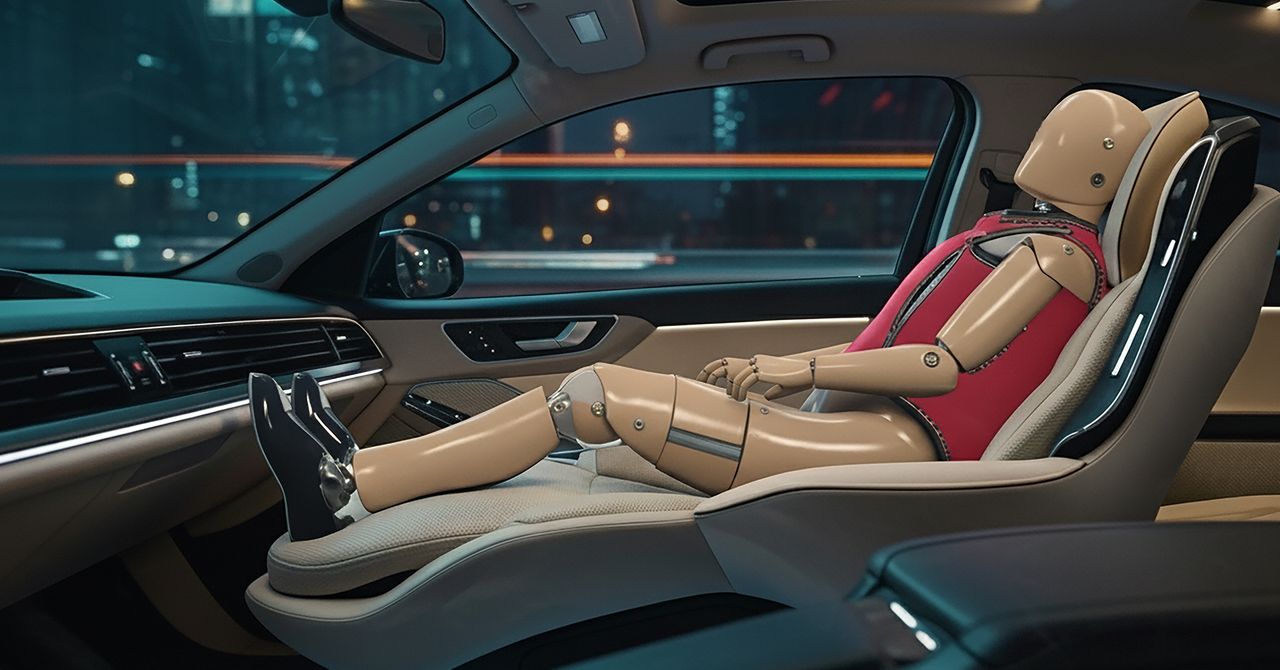
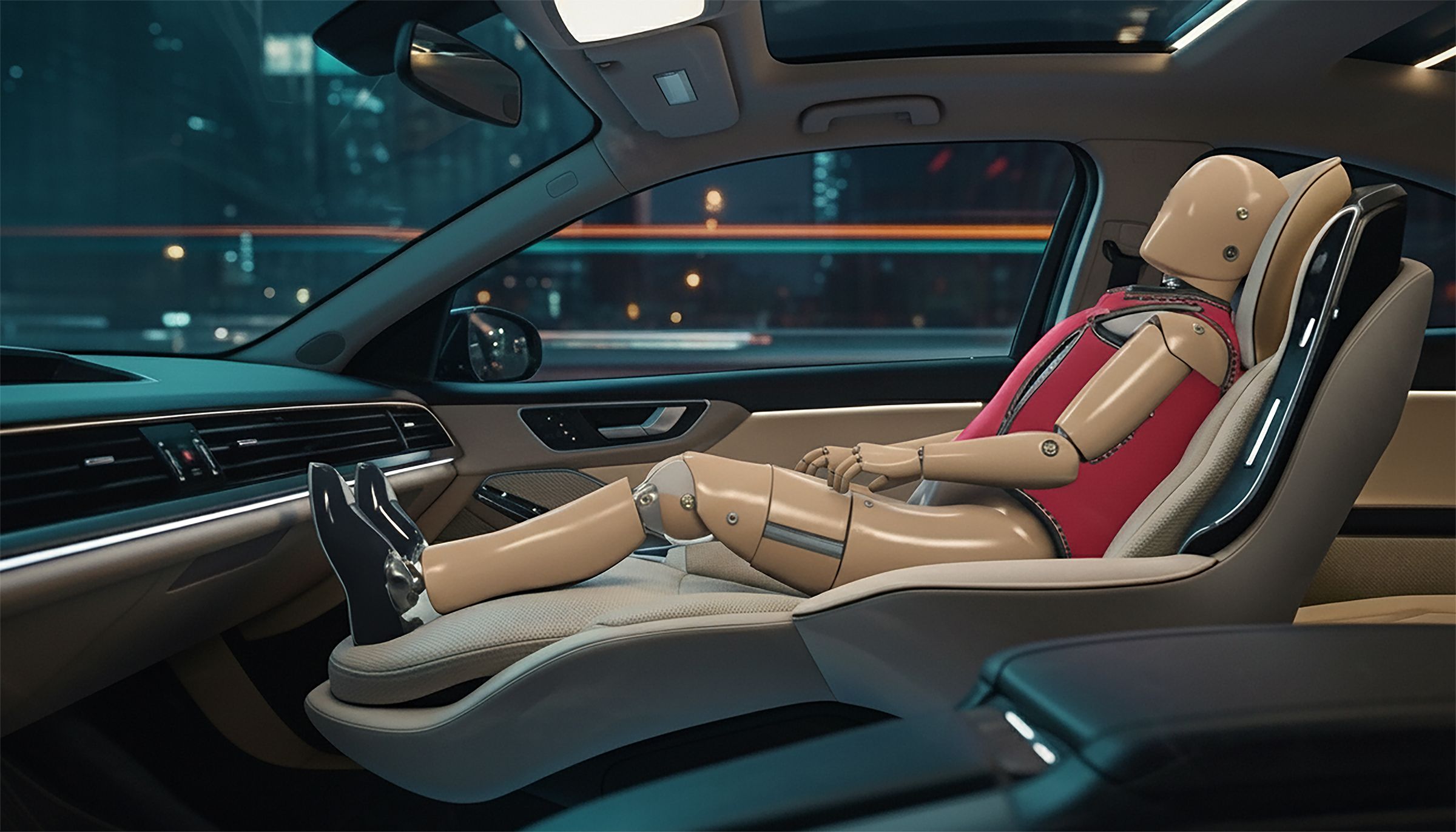
That single finding – stark and largely underappreciated outside safety engineering circles – sits at the heart of a regulatory problem that is growing faster than the solutions being developed to address it. When a vehicle drives itself, passengers naturally shift into positions no crash test has ever been designed to evaluate. Reclined, horizontal, turned sideways, feet up – configurations that were once the exclusive territory of long-haul flights are now showing up in the back seats of prototype robotaxis and consumer autonomous vehicles. The safety infrastructure built to protect people in those positions simply does not exist yet.
What the Old Tests Were Built For
The crash test dummy – that unglamorous workhorse of automotive safety – was engineered to replicate the human body in a seated, forward-facing position. Its proportions, its joint tolerances, its sensor placements: all of it reflects the geometry of a person actively engaged with the driving experience. Frontal impact tests, side-pole tests, rollover simulations – each scenario assumes a specific relationship between the occupant’s body and the vehicle’s safety systems. Change the body’s position, and every calculation shifts.
Airbags are perhaps the clearest example of how position-dependent current safety systems really are. A standard frontal airbag deploys with enough force to protect a seated occupant while simultaneously posing a real injury risk to someone who is out of position – leaning forward at the moment of impact, for instance, or sitting too close to the bag’s deployment zone. Extend that logic to a fully reclined passenger and the problem scales up considerably. The bag deploys where the engineering assumed a face would be. The face is somewhere else entirely.
Seatbelt geometry follows the same logic. The shoulder belt is anchored and routed to work across a torso sitting at a near-vertical angle. When a passenger reclines significantly, that belt can migrate toward the neck or abdomen rather than riding across the chest and shoulder – areas of the body far less capable of absorbing the load forces generated in a serious crash. These aren’t hypothetical failure modes. They’re documented outcomes from research into reclined sleeping positions in conventional vehicles, and the autonomous vehicle era is about to make them far more common.
Governments Are Rethinking the Standards
Regulatory bodies in multiple countries are now being pushed to revisit safety frameworks that haven’t required fundamental revision in decades. The challenge isn’t simply adding a new test or two – it’s reconceiving what a test is supposed to measure when the range of possible occupant positions is nearly unlimited. A driver who must stay alert has a constrained set of postures. A passenger in a fully autonomous vehicle does not. That distinction makes standardization exponentially harder.
The difficulty is compounded by the pace of autonomous vehicle development itself. Automakers and technology companies are iterating on self-driving systems rapidly, and the regulatory apparatus – which typically operates on much longer timelines – is being asked to keep up with a technology that doesn’t wait for rule-making cycles to close. Safety standards that took years to develop for conventional vehicles may need to be rethought on a compressed schedule, without the luxury of the long accident-data histories that informed the original frameworks.
There’s also a philosophical tension embedded in all of this. Current crash safety standards are built on the idea that protection can be engineered around a predictable occupant. Autonomous vehicles shift that assumption toward the idea that the vehicle itself bears more of the protective burden – that the car’s ability to avoid crashes matters more than its ability to survive them. Both things can be true simultaneously, and probably need to be, but the regulatory architecture for evaluating that combined responsibility doesn’t exist in any mature form.

The Gap Between the Technology and the Rules
What makes this moment genuinely difficult – rather than just technically complex – is that autonomous vehicles aren’t a future problem anymore. They’re operating on public roads in multiple cities, carrying real passengers in configurations that current safety standards were never designed to evaluate. The gap between what the technology is doing and what the regulations cover isn’t closing quickly enough, and there’s no obvious forcing mechanism to accelerate the process on the regulatory side. The question isn’t whether crash testing needs to change. It’s whether it can change fast enough to matter before a generation of autonomous vehicles is already on the road.